Trading Bonds If they are allowed in your contest, you can use the [link name=”bonds” dest=”/trading/bonds”]Bonds Trading Page[/link]. Simply select the bond you want to buy or sell, how much you want to buy, and trade! Notes for trading bonds: All bonds, corporate and treasury, that we support are in one master list. We only Read More…

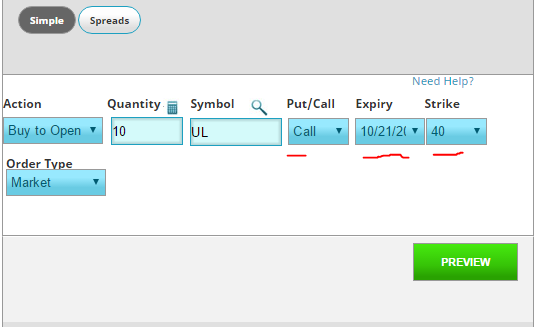
Trading Options If options trading is allowed in your contest, you can use the [link name=”option” dest=”/trading/options”]Options trading page[/link]. Trading options on your simulator is easy but there a few differences between the real world and a simulator. To trade options start by going to the Make a trade => trade options tab. Simple or Read More…
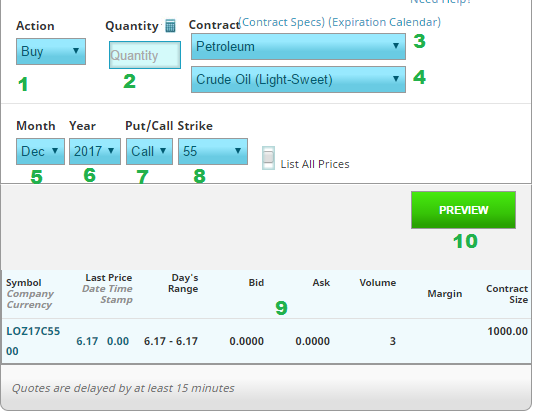
Trading Future Options acts like trading a normal option, but replacing the underlying stock with an underlying future. If your class or contest allows it, you can trade them from the [link url=”/trading/futureoptions” desc=”taradre”]Future Options Trading Page[/link]. Trading Pit Parts of the trading pit: Action – Only “Buy” and “Sell” is available for future options Read More…
Stock Trak – Week 1 Assignment You are a portfolio manager at a private bank and have recently been assigned three new Naples based clients. Martha is 30 years old. She is a single parent and recently inherited a large sum of money. She is looking to buy a home in three years or less, Read More…
Future Options are exactly what their name implies – an option on a futures contract. Futures and Options – Related Derivatives Futures and options are both derivatives – meaning a security whose value solely depends on the value of the underlying asset. A future derives its value from the commodities or currencies which it represents Read More…
If your contest allows trading futures, you can find them on the [link name=”future” dest=”/trading/futures”]Futures trading page[/link]. Action: Here you can select: Buy, sell, short, cover just as you would for stocks. Quantity: Enter the quantity desired of options contracts. Remember even with 1 futures contract you can have huge exposure depending on the contract Read More…
Symbol Month Margin Multiplier Description Exchange Indices Z. HMUZ 5500 10 Dow Jones CBOT ES HMUZ 3850 50 e-Mini S&P 500 (Globex) CME ND HMUZ 12100 100 Nasdaq 100 CME NIY HMUZ 3400 5 NIKKEI 225/Yen CME NQ HMUZ 2420 20 e-Mini Nasdaq 100(Globex) CME TR HMUZ 5280 100 Russell 2000 Mini Index ICE SP Read More…

Grains Contract Sep Oct Nov Dec Jan Feb Mar Apr May Jun Jul Aug Wheat 08/31 11/30 02/28 04/28 06/30 Corn 08/31 11/30 02/28 04/28 06/30 Soybeans 08/31 10/31 12/30 02/28 04/28 06/30 07/31 Soybean Meal 08/31 09/30 11/30 12/30 02/28 04/28 06/30 06/29 Soybean Oil 08/31 09/30 11/30 12/30 02/28 04/28 06/30 07/31 Oats Read More…
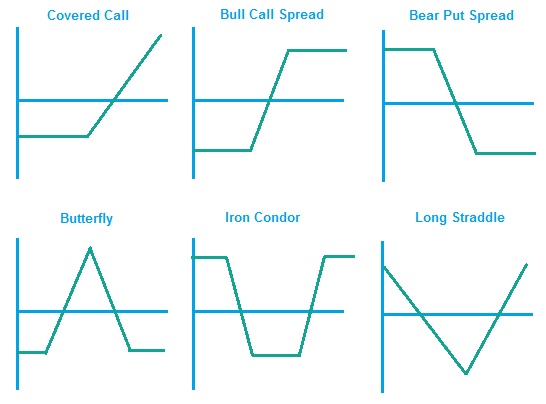
There is an infinite number of strategies that can be used with the aid of options that cannot be done with simply owning or shorting the stock. These strategies allow you select any number of pros and cons depending on your strategy. For example, if you think the price of the stock is not likely Read More…
A straddle is an investment strategy that involves the purchase or sale of an option allowing the investor to profit regardless of the direction of movement of the underlying asset, usually a stock. There are two straddle strategies, a long straddle and a short straddle. How to create a Long Straddle position A long straddle Read More…
You can find the underlying stock price, along with the option strike price, expiration date, and whether it was a “Put” or “Call” right from the option symbol! AAPL1504L85 is the way we write our options and can differ from other websites or brokerages. Our options are written: Symbol Year Day (Call or Put and Read More…
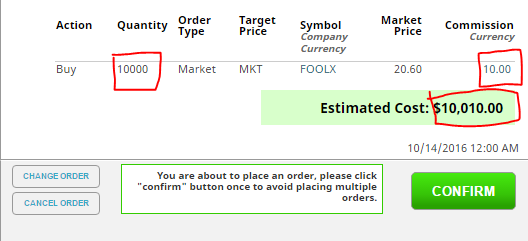
When trading mutual funds on this system, there are a few differences to keep in mind compared to trading stocks. Trading Tip 1: Quantity = Dollars! Unlike stocks, where you specify the number of shares you want to purchase, with Mutual Funds you specify how many dollar’s worth a mutual fund you want to buy. Read More…
STOCK-TRAK Simulation Preliminary Report STEPS: 1. Complete a four-page description of your investment plans using the topics below as an outline (20 + 5 points) Summarize your Strategy, filling in the blocks on this page (5 points; 3 + 2 for forecasts) Staple #2 on #1 and turn in complete report & $2.00/teammate Due Read More…
Texas A&M University-Kingsville College of Business Administration Fall 2016 Course Syllabus Investments FIN 4331 COURSE INFORMATION Credit hours: 3 Prerequisites: Business Finance (FINC 2331) Web-Orientation (and explanation): Face-to-face course, with grade book and various resources online Location/Times: BUSA 104 / 12:00 – 12:50 p.m. M/W/F COURSE INSTRUCTOR Thomas (Tom) Krueger Professor of Finance, Read More…
Bus 410 – Financial Markets Voluntary Extra Credit Project: Simulation Portfolio Management -Stock Selection and Security Trading Fall 2016 This is an optional project for extra credit to be applied to the “Total Grade” earned . Students who participate in this project according to the project guidelines will receive a 5% extra credit allocation towards Read More…

Options Spreads are option trading strategies which make use of combinations of buying and selling call and put options of the same or varying strike prices and expiration dates to achieve specific objectives (hedging, arbitrage, etc.). Option spreads are complex trades, but you can place two “legs” simultaneously using this trading platform. Trading Option Spreads To Read More…

By kidseconposters.com Companies issue stock to raise money to finance business operations. Stock represents ownership in a company. Thus, if you are a stockholder, you own part of a company. A stock certificate shows how many shares you own.

By kidseconposters.com For individuals, saving is the part of one’s income that is not spent. People often place their savings in banks and credit unions, which in turn lend the money to businesses and other individuals. Sometimes people use their savings to purchase financial securities, such as stocks or bonds. It is important to save Read More…

By kidseconposters.com Investing in capital goods occurs when businesses purchase capital goods in order to increase the productivity of workers. This investment always involves some risk.

By kidseconposters.com Financial institutions encourage people to save by offering interest on savings. They loan these savings to businesses and consumers. Banks compete with one another to attract savers and borrowers. The goal of the bank, like any business, is to make a profit.

By kidseconposters.com People often put their savings into financial investments like stocks, bonds, or certificates of deposit. Some of these are more risky — but have the potential of a much better rate of return — than less risky investments. Research the financial investments below. Rate each according to risk and return — with 10 Read More…

These activities are designed specifically to cater towards younger students using the stock game

Teaching a personal finance class? We have some great class ideas on how to integrate the portfolio simulation and educational content with your classes!

To create your contest, log in as an administrator (if you’re seeing this page, you probably already have), and find your Administrator menu at the top left of the page: Video Tutorial This video tutorial walks through each challenge rule, it is about 7 minutes long. Creation Form This is a description of everything you’ll Read More…

Assignments are a great way to manage your class’s activities around the simulation and this learn center, giving you the ability to track your student’s progress in trading, reading articles, and using our calculators. This will be a quick overview of what Assignments are, and how you can best make use of them in your Read More…
Johnson School of Business FIN3000 Personal Finance Project By Professor Anke Stugk, MBA astugk@hodges.edu A study of personal financial management including retirement planning; budgeting; individual taxation; consumer credit; investments such as stock, mutual funds, and annuities; insurance, and major expenses. Prerequisite: MAC1132 or permission of the faculty/program advisor, program chair, and dean. Personal Finance Semester Read More…

Assignments are a great way to manage your class’s activities around the simulation and this learn center, giving you the ability to track your student’s progress in trading, reading articles, and using our calculators. This will be a quick overview of what Assignments are, and how you can best make use of them in your Read More…

To be “In Debt” means to owe money to someone else, usually making fixed payments to pay back the amount over time, plus interest. Debt means different things to different people – having some debt is perfectly healthy for your personal finances, but too much can leave you buried. There is also a major difference Read More…
Assignments are a great way to manage your class’s activities around the simulation and this learn center, giving you the ability to track your student’s progress in trading, reading articles, and using our calculators. This will be a quick overview of what Assignments are, and how you can best make use of them in your Read More…

An “Investing Strategy” is a plan for how to save money to help it grow. Sometimes an “investing strategy” can just mean “plan for trading stocks”, but it really means a lot more. Liquidity, Risk, and Potential Returns All investments balance liquidity (how easily it can be converted into cash for other use), risk (the Read More…

What Is Credit? “Credit” is when you have the ability to use borrowed money. This can come in many different forms, from credit cards to mortgages. There is a wide range of ways to use credit, which means that it is often a challenge for beginners to learn all the different ins and outs of Read More…

3 Ways To Communicate Most changes to the site have a one-week turnaround period for integration, but we do have 3 quick that will improve the way you communicate with your users. These methods always be updated on any information your site would like to deliver – most clients usually use one or two methods, but Read More…

To create your contest, log in (if you’re seeing this page, you probably already have), and find your Contest Menu at the left of the page. Creation Form This is a description of everything you’ll see on that page, and how it impacts your contest: Trading Session Name: This is the name of your class, Read More…

When should someone start planning for retirement? Fidelity Investments recommends most young people try to save up 2x their annual salary by the time they turn 35, which is a pretty good benchmark to shoot for. Unfortunately, retirement is so far off the mind of most young people that they find their retirement account is Read More…

This guide will illustrate the different reporting tools instructors have at their disposal. The Reports page can be accessed under the Administration menu at the top of the page: At the bottom of all Reports pages, there is a button to connect directly with our support team for live support. Video Tutorial This video tutorial will Read More…

What is “Labor”? “Labor” is how much a person works. It is the use of time and exertion of effort to produce something of value. Generally speaking, the more valuable a person’s labor is, the higher their wage. Skilled And Unskilled Labor Each person starts off as an Unskilled Worker, meaning they do not have Read More…

“Unemployment” is a major economic indicator measuring how much of the working population is currently looking for a job. The unemployment rate is the most “tangible” economic indicator – if GDP is going up or down, it is harder for people to notice in their day-to-day lives. When the unemployment rate goes up, it usually Read More…

Definition “Price Controls” are artificial limits that are put on prices. If the limit is put in place to prevent prices from getting too high, they are called Ceilings. If they are in place to prevent the price from getting too low, they are called “Floors”. Price Ceilings Price Ceilings are controls put in place Read More…

What Are Interest Rates? Interest rates are growth rates – it is a percentage that is used to calculate how much a loan or investment grows over time. Interest rates are most commonly associated with borrowing money, like a homeowner taking out a mortgage or a government selling a bond. The interest rate is how Read More…

Definition Scarcity refers to the fact that resources are finite – people and organizations need to allocate their finite resources between their infinite wants. Each year, the world produces more goods and services, along with better technologies and processes that can increase output farther. Even with this growth, there will always be scarcity, because there Read More…

Definition “Specialization” is when a labor force begins to divide total production, leading to a rise of experts or specialists. This is called the Division of Labor, and it typically results in much higher productivity of labor. How Does It Work? Specialization has two main parts – Division of Labor, and a rise of Experts. Read More…

Definition “Opportunity Cost” is what needs to be given up to get something. This is different from an item’s price. Imagine you want to buy some stock for your virtual portfolio – you can afford one share of either Apple () or Alphabet, Inc. (). Your Opportunity Cost of buying one is that you cannot also Read More…
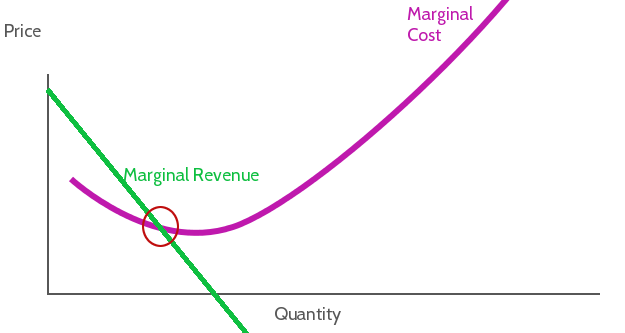
Everyone knows about costs and benefits of doing something – the pros and cons of making a choice. Marginal benefit and marginal cost are different – they look more closely at doing slightly more or less of different alternatives. Marginal costs and benefits are extremely important to producers when choosing their inputs and prices. [gtranslate] Read More…
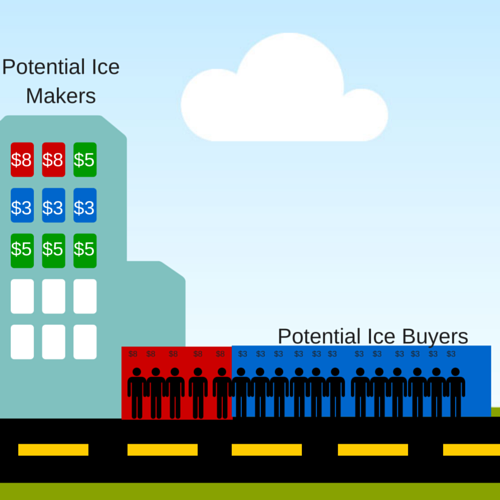
What is Competition? “Competition” is when many producers try to sell similar goods to the same set of consumers. The producers need to “compete” to try to attract more consumers, usually by lowering prices, offering better versions of the goods or services, or through marketing. Competition is the core concept of the Market Economy. Why Read More…

What Is The Business Cycle? The Business Cycle is the broad, over-stretching cycle of expansion and recession in an economy. The Business Cycle is concerned with many things – unemployment, industrial expansion, inflation rates, but the most important indicator is GDP (Gross Domestic Product) growth. Below you can see a graph of the GDP growth Read More…

What does it mean to be an Entrepreneur? An Entrepreneur is someone who takes a risk to start a new business. Nearly every business that exists (apart those created as spin-offs of other businesses, or by government intervention) was started by one or several entrepreneurs, who took a risk to launch a new company. Who becomes Read More…

Definition Economic Incentives includes anything that pushes people, businesses, and governments to do one thing or another. This includes what products you buy, what career you choose, what products businesses produce, and what government programs are put in place. Incentives for Individuals Each individual faces many economic incentives every day. If you are in school, Read More…

Definition In Economics, an “Externality” is a benefit or cost that is not reflected in the price of a good or service. Why do Externalities Exist? Prices are determined by the relationship between the supply and demand of a good or service (for details, see our article on Supply and Demand Examples in the Stock Read More…

What is Economic Growth? Economic Growth means that the economy is growing – more goods and services are being produced and consumed than they were before. The most common measurement of economic growth is the Gross Domestic Product (or GDP), which measures the total number of finished goods and services produced in an economy in Read More…

Definition A “Contract” is a legally binding agreement between two parties (people, companies, or both). Having a contract means that if one party does not keep their word, the other can sue them in court to either force them to fulfill their side of the agreement, or pay back compensation. What Makes A Contract Binding? Read More…

Definition “Economics” is often called the Dismal Science – it studies the trade-offs between making choices. The purpose of economics is to look at the different incentives, assets, and choices facing people, businesses, schools, and governments, and see if there is any way to improve outcomes. This is done by looking at how supply and Read More…

Have you ever wanted to start a business? Maybe you want to know the difference between a lemonade stand and Minute-Maid, besides just the size of the companies. Different types of companies have different levels of liability (meaning level of responsibility) for the owner or owners. What this means is that the more liability an owner has, Read More…
Investing101 Final Exam
9-11 Chapter 9 Exam
8-12 Chapter 8 Exam
7-16 Chapter 7 Exam
6-11 Chapter 6 Exam Below is a basic quote for US Steel (Ticker symbol: X) from July 2021, along with the financial statements from the years ending in December 2020 and December 2019 (so you have two years of data to compare). Many of the questions in this exam will reference these financial statements.
5-09 Chapter 5 Exam
4-08 Chapter 4 Exam
3-10 Chapter 3 Exam
2-12 Chapter 2 Exam
1-14 Chapter 1 Exam
Net Worth Calculator! Knowing your net worth is the first step towards growing it! This tool will help you organize your assets in one place, and even help project how they will grow in the future. If you have used our Home Budget Calculator to help see where you can improve your savings, the next Read More…
[link name=”validlink” dest=”/account/validatecode?code=4000021″]If this was part of an assignment, Click Here to confirm you’ve read it[/link]
Dollar Cost Averaging is a great way to get an average price for a stock. Combine that with a Dividend Reinvestment Plan (DRIP) you are on your way to build steady wealth. Please watch the video below to learn how to use these concepts to your advantage. [link name=”validlink” dest=”/account/validatecode?code=4000020″]If this was part of Read More…
Please watch the two videos below before beginning the assignments posted below. [link name=”validlink” dest=”/account/validatecode?code=4000019″]If this was part of an assignment, Click Here to confirm you’ve read it[/link]
A market is a place of exchange that allows buyers and sellers of a specific good or service to interact in order to facilitate an exchange. The price that individuals pay during the transaction may be determined by a number of factors that we will discuss later. Although there are many types of markets Read More…
In the first chapter we learned about what markets were, and specifically talked about the stock market. You might still be wondering though what is stock? As we talked about in the Apple example, stock is a type of security that signifies ownership in a corporation and represents a claim on part of the Read More…
This table of data is kind of table that you will see when you type a stock or stock symbol into the Yahoo! Finance search tab. The top line shows us that we are looking at information regarding Annaly Capital Management, Inc. Stocks are denoted by symbols that are unique to that stock. For example, Read More…
What makes stock prices go up and down? Most people would tell you that supply and demand makes stock prices go up and down, and most people would be wrong. Price discovery is the actual reason tha makes stocks go up and down and is a difficult concept to understand that is too often comapred Read More…
Liquidity can be hard to explain with respect to stocks, but an easy way to start thinking about liquidity is by picturing a water bottle with one of two things in it, water or concrete. If you took a water bottle with concrete in it, twisted off the cap and flipped it upside down, nothing Read More…
There are three phases of the market that you need to know to understand how markets move and work. The three phases of the market are congestion, breakout, then blow off. The first phase of the market is congestion. The market is in congestion more than 65% of the time. Congestion can be hard to Read More…
Risk vs. Reward is one of the most important concepts when it comes to our trading. It is important to realize that when we are trading, we are not gambling. Our trading revolves around calculated risks that will make us successful in the long run. It is a beautiful thing that when we trade, we Read More…
This section builds directly off of the last one because it reiterates the fact that we are not gambling when we are trading. Your personal opinion and emotion must be left at the door. The only thing you should be looking at is the levels on your chart. There is nothing more dangerous than a Read More…
We have talked a little bit about trading stocks. You might be wondering though, “How do I know which stocks to trade?” We also have a set of rules in place for finding the right stocks for you to trade. The key to technical trading is to find the levels you want to trade. It Read More…
We’ll pick up right where we left off last section. Your watch list comes directly from the stocks that you screen for. We want our watch list to consist of 20 stocks from the screening section. It may seem like a hard task to pick only 20 stocks from that big of a list, but Read More…
There are many different types of orders you can place in the stock market, and it is important to know the difference between all of them. Let’s start with the two most basic types of orders that we should be aware of. A market order is an order to buy or sell immediately at the Read More…
Please watch the videos below showing you how to place a buy order with a 3% stop. A buy order is also called a long position because we always want to place our orders off of the levels we create when making our watch lists. [link name=”validlink” dest=”/account/validatecode?code=4000012″]If this was part of an assignment, Read More…
Once your stock has been filled you always want to protect your downside risk. The recommendation for trading stock is to place a stop order 3% lower than what you paid for the stock. For example, if you bought a stock for $37.00 per share you would want to put your stop in by taking Read More…
We are now onto the last step of learning how to trade. This step is the most exciting one as we actually get to use charts and make trades off of them. Our style of trading revolves around identifying patterns within charts. We have two main patterns that we use, they are called double tops Read More…
Options are one of the most misunderstood concepts in trading. Many people do not trade options because they have false beliefs that options are too risky. The truth is that they just don’t know how options really work. Options are actually the most beneficial for young traders because they don’t require nearly as much capital Read More…
Volatility is a critical concept to understand when trading options. The volatility in the market place can give us a lot of information regarding how we should be trading options. So many people trade options without evaluating the true market value of the options they are trading. This is a peculiar phenomenon because these people Read More…
We have briefly gone over what a call option is, but let’s make it a little clearer. When you buy a call option, you are betting that a stock will go up. Here are three important components that affect the price of an option. Strike Price= the price at which you are allowed to buy Read More…
This chapter will basically be a mirror image to the last one. We have briefly gone over what a put option is, but let’s make it little clearer. When you buy a put option, you are betting that a stock will go down. Let’s move right to option chain this time, but now we are Read More…
This is a basic lesson plan talking about what savings bonds are, how the government uses revenue from bonds, and why it might be a good way to start saving as early as possible. We have more resources on Bonds available in our Education Center, but you can also give your students a great interactive Read More…
10-06 Summary Congratulations! You made it through the basic investing course unscathed, armed, and ready to begin a long, successful investment career. You have enough information to begin with some confidence. Remember, you can test your personal investment strategy using the real world simulation. You’ll get all the excitement and results you’d achieve in the Read More…
10-05 Develop an Investing Strategy That Feels Right for You Throughout this course, we talked a lot about setting goals for yourself, the importance of diversification, and some concepts like “Swing Trading” and “Buy and Hold”. From this point forward, you need to build your own investing strategy – an approach to investing that is Read More…
10-04 Practice, Practice, Practice Every skill you will ever acquire requires a lot of practice, and investing is no different. You should have started building your practice portfolio by now as part of this course – if you have not, you have been SERIOUSLY missing out. Even after this course, there are free practice portfolios Read More…
10-03 Staying Informed Even if you start out as a “buy and hold” investor, staying informed at all times is a critical component to your investment career. Should you be tempted to walk the ever-exciting and dangerous tightrope of day trading, your stream of current information is even more important. Here are some suggestions that Read More…
10-02 Ten Mistakes to Avoid 1. Over-diversification. Sure, every expert with a pencil, computer, or microphone keeps telling you to diversify your portfolio. They are right, but they often neglect to tell you the rest. For example, assume you only have $200 to invest. You buy 40 different stocks at $5 each. Guess what? Now Read More…
10-01 Ten Keys to Remember Here are ten important things to remember as you take the next step in your investing journey. These are real world keys that you should embed into your conscious brain to help you become a consistently smart or profitable investor. 1. Understand and control the fees and costs of your Read More…
9-10 Resources Summary Options are exciting investment “vehicles,” but to be used profitably, you need to understand what they mean and what they can or cannot do for you. You have now scratched the surface of the option world. You’ve now reached a level that gives you some ammunition and skills to play the basic Read More…

Options are an important instrument for many traders, and to understand options you need to understand options tables and learn how to read option tables! Depending on the software or website you use, the actual information may vary, but all tables have these basic sets of information: Calls Puts Strike Vol Expiry Last Chg Bid Read More…
9-09 Put Versus Call Interest Put and call interest does not involve the banking definition of interest, but the market excitement – or lack thereof – regarding puts or calls for a security. Before you start thinking we’ve all lost our analytical minds, try to understand that market prices for stocks and put/ The right, Read More…
9-08 Option Pricing – Black-Scholes Model Any discussion of options and option prices would be incomplete without a mention of the The most generally accepted option pricing model. Black-Scholes option pricing model. Academics Fischer Black and Myron Scholes, in a paper they authored in 1973, stated their theory that an option was implicit to the Read More…
9-07 Implied Volatility What is implied volatility? It is the forecast of current stock price movements with the theoretical value of the market price in the future. It is determined by time, expected movements, and supply and demand. In general, implied volatility (IV) increases in bearish markets and decreases in Bullish markets. Implied volatility Read More…
9-06 Volatility Volatility is a concept that involves all types of securities. For good reasons, high volatility is most often viewed as a negative in the investment world since rapid movements in market prices inherently involve both wins and losses. In investment language, volatility implies two scary conditions for you uncertainty and risk. If you Read More…
9-05 Writing Covered/Naked Calls We noted earlier that 35% of option buyers lose money and that 65% of option sellers make money. Option trading comes down to the turtle and the hare story. Option buyers are the rabbits that are generally looking for a quick move in stock prices, and the option sellers/writers are the Read More…
9-04 Making Your First Option Trade Now that you have a high level understanding of what options are, let’s look at option trading in a little more detail. When you get a quote on a stock you can also call up its option chain: First of all, you must realize that not all stocks have Read More…
9-03 Put Options Whereas a call option gives the holder the right to buy the stock at a certain price, a put option gives the holder the right to sell the stock at a certain price. A trader that buys a The right, but not the obligation, to sell a stock at a certain price Read More…