Workplace Rights, Safety, and Equity in Canada

Starting any new job can be stressful, especially near the beginning of your career when you have a lot to learn about your role, the company, and the industry you’re working in. Between 900 and 1,000 workers in Canada die from work-related causes in a typical year. In this lesson, we go over the laws that protect Canadians, so you will know your rights and responsibilities for keeping yourself and your co-workers safe. No matter what career path you end up taking.
Which Laws Apply to Your Job
Provincial laws govern most Canadian jobs. If you work in retail, restaurants, manufacturing, or local services, your province sets your minimum wage, hours, and holiday pay.
The federal government regulates about eight percent of the Canadian workforce under the Canada Labour Code. This group includes banking, telecommunications, airlines, and interprovincial transport. If you work for a railway or an airline, federal laws protect you. It does not matter if your office sits in a single province.
In Quebec, provincial workers are covered by the Act respecting labour standards (Loi sur les normes du travail). It sets minimum standards for minimum wage, hours of work, statutory holidays with pay, annual leave with pay, and restrictions on work performed by children.
If you’re unsure about which laws apply to your job, you can ask someone from HR or check your employment contract. It’s helpful to know what your rights and obligations are before a problem turns into a complaint.
Core Labour Standards and Protections
Even if you earn a flat salary, your total pay divided by your hours must equal at least the minimum wage. Employers must pay you on schedule; while your work shifts must respect legal limits on daily and weekly hours.
You also deserve paid time off. Provinces recognize specific statutory holidays. On these days, you either get a paid day off or earn premium pay for working. You also earn paid annual vacation, which grows the longer you stay with the company. These rules, alongside protected leaves for family emergencies or illness, form the baseline of Canadian labour standards.
Federal employers follow the Canada Labour Code. The government adjusts the federal minimum wage for inflation every year. It rose to $18.15 per hour in April 2026. This rate applies to paid interns and hourly employees alike. If your province has a higher minimum wage, your employer must pay you the higher provincial rate.
What happens if your boss cancels your shift at the last minute? Under federal rules, if you show up, the employer must pay you for at least three hours. If your employer owes you wages, vacation pay, or holiday pay, the federal Labour Program can help you recover owed money up to 24 months back.
Exact entitlements differ by province and by federal versus provincial coverage, so read your offer letter and your province’s employment standards page rather than assuming it will be like the last place you worked.
Child-Work
Child-work rules differ by province because education and safety risks differ by age and industry. Under the Canada Labour Code, the minimum age of employment for federally regulated jobs is generally 18. Provincial rules govern most local employers.
For example, Quebec law bans hiring children under 14, except for specific roles like tutoring or babysitting, which require written parental consent. Quebec also caps weekly hours for students during the school year. Manitoba and Saskatchewan require young teens to complete readiness courses before starting work. Always check your local rules before accepting shifts that conflict with school.
Hiring and Probation Periods
Quebec’s Charter of Human Rights and Freedoms guarantees you a fair, non-discriminatory hiring process. Once hired, you will likely start on probation. This trial period lets you and your employer decide if the job fits. However, employers cannot set arbitrary rules during probation. In Prince Edward Island, the law sets a six-month probation period. During these months, either side can end the job with minimal notice. Other provinces use shorter probation periods or let employers outline terms in a contract. If an employer fires you unfairly or refuses to pay you, you can challenge them. Use your province’s labour standards office or human rights commission to fight back.
Strict limits on work hours protect your personal life. They ensure you have time for school, family, and rest.
Safety Obligations, Safe Practices, and Enforcement
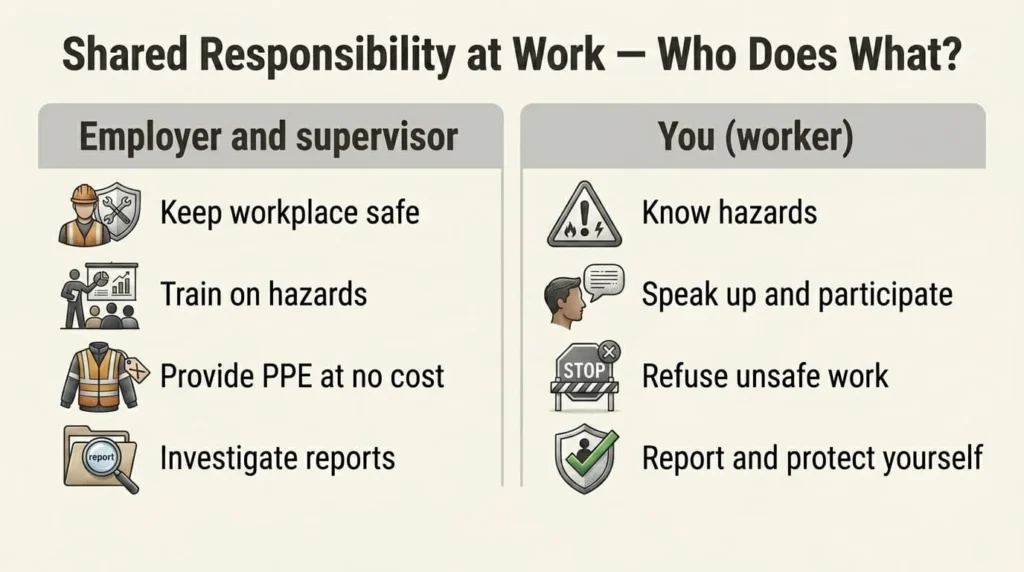
Safety at work is a team effort. Under Canadian law, you and your employer share the duty to prevent injuries. Canada relies on the Internal Responsibility System. This system means everyone at the workplace is responsible for safety. You do not wait for a government inspector to show up and fix a hazard.
You have three fundamental safety rights:
Right to Know
You have a right to know about both potential and actual hazards and how to work safely.
Right to Participate
You have a right to participate in workplace health and safety activities, like reporting hazards, being a member of a committee, or serving as a worker health and safety representative.
Right to Refuse
You have the right to refuse unsafe work without being negatively impacted.
Employers must take reasonable precautions to keep the workplace safe. They must warn you about hazards, train you to work safely, and provide personal protective equipment (PPE) for free. Larger workplaces must set up joint health and safety committees. These committees bring workers and managers together to find and fix hazards. Your supervisor must explain the risks, investigate your concerns, and enforce safety rules.
You also have a responsibility to maintain a safe working environment. You must follow your safety training, wear your PPE, and work carefully. Report hazards, injuries, and near-misses to your supervisor immediately. A near-miss is an event that almost caused an injury. Reporting a broken ladder today is much cheaper than treating a broken leg tomorrow.
If you believe a task is unsafe, tell your supervisor you are refusing the work. Explain your reasons clearly. You, your supervisor, and a safety representative will investigate the hazard together. If you resolve the issue, you can return to work. If you cannot agree, a government inspector will visit, investigate, and issue a final decision. Your employer cannot fire or punish you for raising a safety concern in good faith.
Safe habits protect you everywhere. You practice safety when you lock up chemicals at home, wear a bike helmet, or clean up a spill at work. Your employer will have safety policies, fire exit routes, and equipment checklists. Read these on day one. Do not wait for an emergency. Workplace policies and procedures exist to protect employees and employers alike.
Canada uses the Workplace Hazardous Materials Information System (WHMIS) to label dangerous chemicals. You do not need to memorize every WHMIS symbol today. Instead, read chemical labels, ask for training, and follow storage rules. Your employer must certify you if your job requires handling dangerous goods.
Government inspectors enforce safety laws through random workplace checks. If an employer ignores the rules, inspectors can order immediate fixes or shut down the job site. In extreme cases of neglect, police can charge employers with criminal negligence under the Westray section of the Criminal Code.
Quebec divides labour duties between two main groups. The Commission des relations du travail handles unions and bargaining. The Commission des normes, de l’équité, de la santé et de la sécurité du travail (CNESST) handles safety inspections and injury compensation. Other provinces split these duties among different boards. The names change, but the system remains the same.
Equity and Anti-Discrimination
Imagine a retail clerk who faces constant harassment from a regular customer. Her manager tells her to ignore it because the customer spends a lot of money. This response violates the law. Employers must protect you from harassment, whether it comes from a co-worker, a contractor, or a customer. In 2024, Quebec passed Bill 42 to strengthen safety rules against workplace harassment and sexual violence. If you face harassment, write down the dates, times, and witnesses. Report the abuse to your supervisor or an outside human rights agency.
Human rights laws ban discrimination in hiring, pay, and promotions. Employers cannot treat you differently based on your race, gender, disability, sexual orientation, or family status. Federal employers must also follow the Employment Equity Act. This law works to dismantle barriers for women, Indigenous peoples, people with disabilities, and visible minorities.
Employers must accommodate your needs unless doing so causes them severe financial or safety risks. This is called “undue hardship.”
Respectful behaviour is a daily habit too. Use inclusive language, reject offensive jokes, and speak up when you see others face discrimination. If your manager or HR department refuses to help, you can file a complaint with your provincial or federal human rights commission. Keep clear, written records of every incident.
Professional Success at Work
Employers notice reliability before they notice brilliance. Being a reliable employee includes the same kind of skills you already have been practicing (whether you realize it or not) at school and in your personal life. Show up on time when scheduled to work, communicate with your team before small problems grow into major conflicts, own your mistakes, and treat your co-workers with respect. These habits are what people mean by meeting employer expectations.
Business etiquette shapes your professional reputation too. A bank manager expects different clothes than a kitchen chef, but both expect you to look ready to work. Do not roll into a shift looking like you just rolled out of bed. Arriving five to ten minutes before your shift starts is standard in Canada. Greet your team when you walk in, and try to avoid workplace gossip that brings other people down.
Being a trustworthy person at work is just as important as it is everywhere else. Trust works like a bank account. Each kept promise, honest update, and respectful conversation is a deposit in your “trust account.” However, broken promises, blaming others, or saying negative things about other team members behind their back, drains your account fast. People like working with people they can trust. If your manager can rely on you, they are more likely to put your name forward for a promotion or a new project, than someone who is inconsistent, rude or dishonest.
The Unwritten Rules of Workplace Trust
Every workplace operates under an invisible social contract. We split this into two parts: culture and climate. Culture is the long-term character of the business. It dictates how colleagues treat each other over years. Climate is the temporary mood of the office this week. While a sudden policy change or a stressful client can ruin the climate overnight, building a healthy culture takes years. The healthiest cultures encourage employees to speak up. If workers are too afraid to report mistakes, even the best business plans fail.
You shape this daily climate through the promises you keep. Imagine your bus breaks down on your morning commute. If you text your supervisor at 7:02 AM instead of 7:31 AM, you show respect for their schedule. You turn a potential warning into a minor delay. This same respect applies to your inbox. Write clear subject lines, keep your emails focused on a single request, and use a professional sign-off. When you manage expectations early, you build professional trust.
Canadian workplaces often seem deceptively relaxed. Most managers prefer first names, and dress codes are increasingly casual. Do not mistake this informality for a lack of standards. This flat structure exists to encourage open dialogue. Supervisors welcome your ideas in meetings, even if you are the newest person in the room. However, you must still listen carefully before you speak.
Active communication is not just for office workers. A dishwasher who flags a slippery floor behind the kitchen line protects the crew. A receptionist who confirms tomorrow’s appointments protects the business’s cash flow. Both use clear communication to solve problems before they grow.
Your Social Insurance Number
Before your first shift, your employer will ask for your Social Insurance Number (SIN). This nine-digit number links your job to the tax system. The government uses it to track your earnings, pension contributions, and taxes. You can apply for a SIN through Service Canada. You will need a primary ID, like a passport, study permit, or permanent resident card.
Guard your SIN carefully. It’s the key to your financial identity. Only share it when the law requires it, such as with a new employer or your bank. Never use it as everyday ID. Do not carry your physical SIN card or document in your wallet. Memorize the number or store it in a secure, encrypted app instead.
If someone steals your SIN, they can open credit cards or claim benefits in your name. If you lose your number, report it to the local police immediately. Next, call the Canadian Anti-Fraud Centre at 1-888-495-8501 and contact Canada’s credit bureaus to freeze your credit.
Where to Get Help
If your boss refuses to pay you or ignores a hazard, you may need outside help. Start with the specific agency that handles your issue:
| Your Problem | Where to Start (Examples) |
|---|---|
| Unpaid wages, missing vacation pay, improper notice | Provincial employment standards office, or the federal Labour Program (ESDC) |
| Injury or illness from work | Workers’ compensation board (CNESST in QC; WSIB in ON; WorkSafeBC in BC) |
| Discrimination or harassment | Human rights commission (provincial or federal) |
| Unsafe conditions nobody fixes | Occupational health and safety inspector or CNESST prevention services |
| Union rights, collective agreements | Labour relations board (Commission des relations du travail in QC) |
In Quebec, if you do not belong to a union, you must file wage and safety complaints with the CNESST. The CNESST often provides free mediation to help you and your employer resolve disputes before launching a full investigation. If you belong to a union, file a grievance through your union representative instead.
If you work in a federally regulated job, contact the federal Labour Program for wage theft, or the Canadian Human Rights Commission for discrimination.
If you work elsewhere in Canada, search your province’s name and “employment standards” on an official government website to find the right agency.
Leaving or Losing a Job
Jobs eventually end. You might quit, face a layoff, or get fired. Each path requires different paperwork and notice.
If you decide to quit, give your employer reasonable notice. While laws vary, two weeks is the professional standard for most entry-level jobs. Put your resignation in writing, keep a copy, and finish your remaining shifts professionally. Finally, make sure your employer includes any unpaid vacation pay on your last paycheque.
If your employer fires or lays you off, they must usually give you written notice or pay you for those notice weeks. In Quebec, your notice period grows with your service. You get one week of notice after three months on the job, two weeks after a year, and up to eight weeks after ten years. Employers do not owe you notice if you worked there for less than three months, finished a temporary contract, or got fired for serious misconduct.
Quebec courts can also demand longer “reasonable notice” under the Civil Code. Suppose a company recruits you away from a stable job you held for years, promises long-term work, and lays you off after eleven months. A court might award more notice than the single week under standard labour standards because the recruitment and your reliance on the promise changed what “reasonable” means.
Large layoffs can trigger extra notice rules. In Newfoundland and Labrador, terminating 50 or more employees within four weeks is a group termination with extended notice requirements.
When you leave a job, your employer must submit a Record of Employment (ROE) to Service Canada. The government uses this document to decide if you qualify for Employment Insurance (EI) benefits. Keep your pay stubs, termination letters, and ROEs in a safe folder. If you lose your job through no fault of your own, EI can provide temporary cash while you search for your next role. Check the Service Canada website for current rules and applications.