Workplace Success, Safety & Employee Rights
Mike and Tony both get paid $16 per hour. Mike’s warehouse posts schedules a week ahead, runs regular safety training, and has a written way to report problems. Tony’s job pays the same but swaps shifts by last-minute text, skips equipment checks when orders spike, and treats safety complaints as slowing the line. Same wage. Very different jobs.
A paycheck is one line on the offer. You also need to know what the employer expects from you, whether the workplace has real safety systems, and what protections you have if something goes wrong. Culture, safety habits, and worker rights support a job the way a foundation and roof support a house. Square footage looks impressive until the roof leaks.
Roughly nine in ten job seekers say culture matters at least somewhat when they choose where to work. About one in three would take less pay for work they care about. Those numbers do not make pay unimportant. They show that people notice unclear expectations, ignored hazards, and workplaces where speaking up feels risky.
Professional Success on the Job
Professional success starts with meeting clear expectations: showing up when you said you would, communicating before small problems grow, owning your mistakes, and working with other people instead of around them. A strong work ethic is what coworkers notice when those habits stick. They can count on you to show up, tell the truth about problems, and care about the quality of what you produce.
Professional etiquette is how those habits look day to day. Dress and grooming should fit the job. A corporate office and a kitchen line have different norms, but both expect you to look like you belong there. Arrive on time, greet people respectfully, and skip gossip that damages someone else’s reputation. In email and meetings, listen before you interrupt, answer what was asked, and put plans in writing when timing matters.
Trust works like a bank account. Each kept promise, honest update, and respectful conversation is a deposit. Broken promises, blame-shifting, or talking behind someone’s back drain it fast. Managers promote people they can rely on: coworkers who do competent work, admit errors, and treat the team fairly. That trust builds slowly and can shape your whole career.
Culture, Climate, and Clear Communication
Culture
Workplace culture is the pattern of how people treat each other over months and years. Culture moves much slower.
Climate
Climate is the mood on any given week. One bad incident or one new policy can change climate quickly.
A solid business plan still fails where people are afraid to raise problems.
When you are running late or need to swap a shift, call or message early. You show respect for the team’s time and keep a scheduling snag from turning into a performance issue. Direct feedback helps too. Vague praise and vague criticism both waste time; say what happened and what should change next.

Workplace Safety and Risk Reduction
You get to work and you notice a frayed wire near a busy workstation. Would you report it? Would anyone fix it?
Your answer says a lot about the employer’s safety habits. Workplace safety protocol covers the rules you follow, the training you receive, and the equipment you use to avoid injury. Hazards are real. Globally, millions of workers die or get injured on the job each year. Safety rules exist to cut those numbers and to protect employers from shutdowns, lawsuits, and the cost of replacing experienced workers.
When someone gets hurt, the medical bill is often the smaller part of the damage. Lost time, investigations, training replacements, and broken equipment can cost several times more than treatment alone.
Hazard Prevention and Shared Responsibility
The strongest fix for a hazard is to remove it during design or planning, before anyone needs extra gear to work around it. When removal is not possible, workplaces rank controls from most to least reliable: eliminate the hazard, substitute something safer, engineer guards or barriers, change procedures, and only then rely on personal protective equipment (PPE) as a last line. That ranking is called the hierarchy of controls.
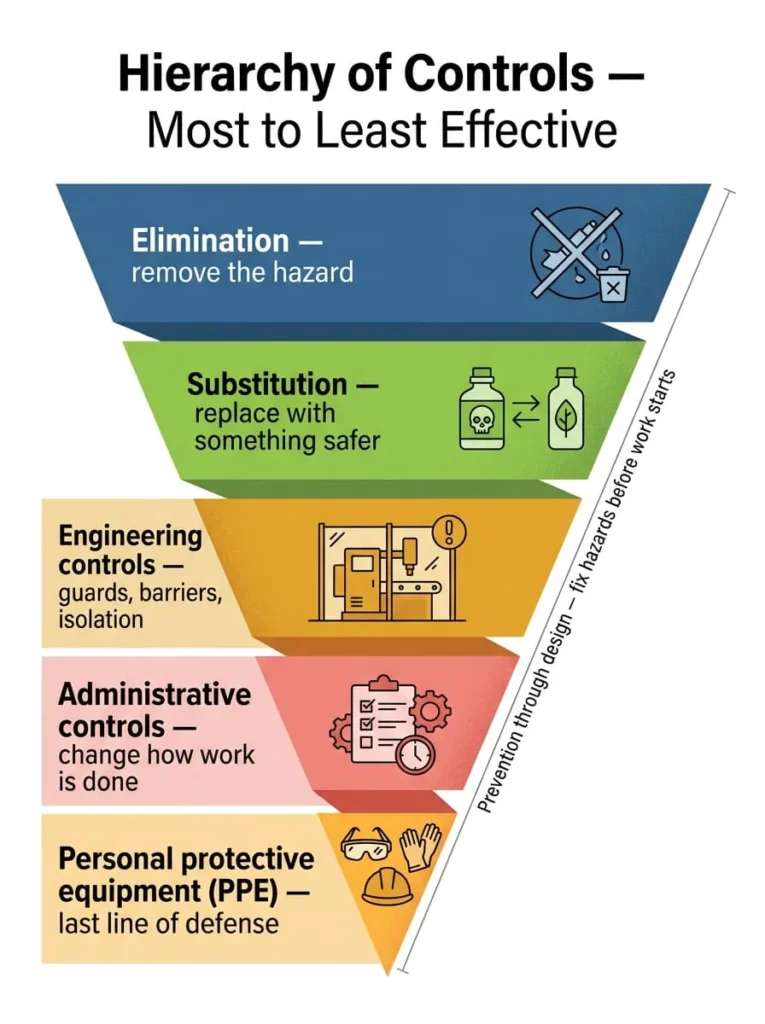
Safety is a shared duty, sometimes called the internal responsibility system. Employers must assess risks, maintain equipment, train workers, and provide required PPE without charging you for it. You must follow training, use equipment correctly, and report hazards or near-misses right away. A near-miss is an almost-accident. In a healthy workplace, near-miss reports are a good sign. Workers trust that speaking up leads to fixes, not punishment.
Strong Safety Culture:
Someone reports the frayed wire and it gets repaired quickly.
Weak Safety Culture:
Supervisors treat safety as a nuisance, minor issues stack up, and a small oversight can become a serious injury.
Neither side can carry safety alone. Everyone has a role to play to keep the workplace safe for everyone.
Under the Occupational Safety and Health Act (OSHA), you have the right to report unsafe conditions without retaliation and to refuse work you reasonably believe poses an imminent, serious danger to your health or safety.
Unions, collective bargaining, and employee rights
Working conditions include more than hourly pay: hours, overtime rules, break policies, safety standards, how discipline works, and whether seniority affects layoffs or preferred shifts.
Several federal laws set floors across the United States. The Fair Labor Standards Act (FLSA) sets the federal minimum wage and requires overtime at 1.5 times your regular rate for hours over 40 in a workweek. The Family and Medical Leave Act (FMLA) gives eligible workers up to 12 weeks of unpaid, job-protected leave per year for certain family and medical reasons. Title VII of the Civil Rights Act bans employment discrimination based on race, color, religion, sex, or national origin. The National Labor Relations Act (NLRA) protects union and non-union workers alike from retaliation for protected concerted activity, such as discussing pay, schedules, or safety concerns with coworkers.
Workers can also form a union and use collective bargaining to negotiate wages, benefits, schedules, safety practices, and other terms as a group. Negotiations may produce a collective bargaining agreement (CBA), a binding contract between the union and the employer. If the CBA conflicts with your individual offer letter, the CBA usually wins.
Union dues are regular payments members make to fund representation, legal support, and strike funds. Dues reduce take-home pay. Union members often negotiate higher pay, stronger benefits, and more predictable rules. Dues are still a real cost you should weigh against those gains. Only about 10% of U.S. workers belong to unions, with much higher rates in public sector jobs than in private industry.
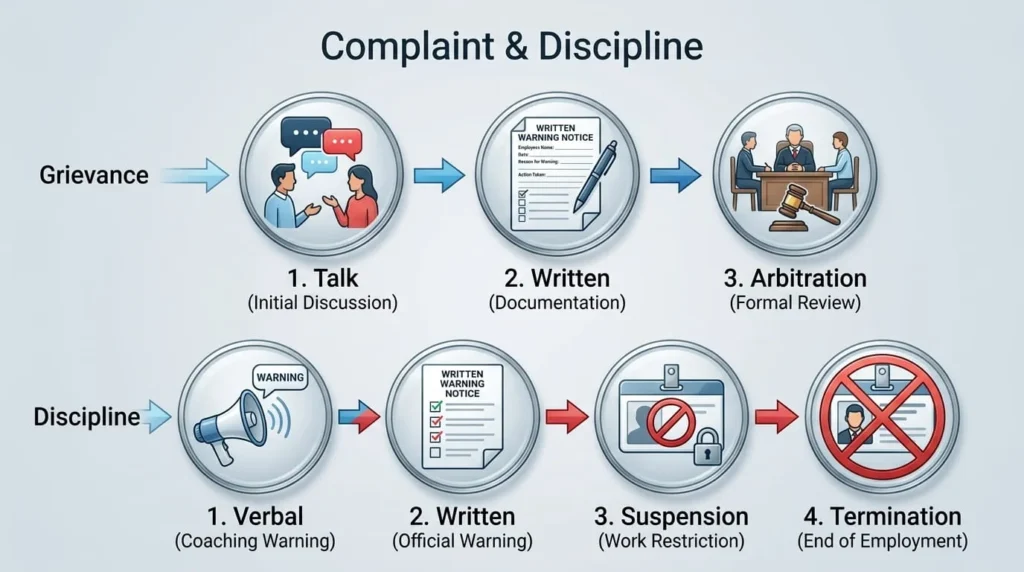
If management breaks the CBA, members can file a grievance. A grievance procedure typically starts with a conversation with a supervisor, moves through written steps, and may end in outside arbitration. Many union contracts require just cause before serious discipline or firing. They also use progressive discipline instead of firing someone for a first minor mistake: usually a verbal warning, then a written warning, then suspension, then termination. Union members also have Weingarten rights to union representation in investigatory meetings that could lead to discipline.
Seniority usually means longer-tenured workers get priority for shifts, overtime, or protection during layoffs. In many contracts, layoffs follow a last-hired, first-fired rule. Policies vary by employer and contract, but the contrast shows why workers sometimes choose collective bargaining.
Construction is a high-injury trade where policy details matter as much as hourly pay. Compare two crews earning similar wages on paper: one on a private non-union job, the other with a unionized employer that has a collective bargaining agreement.
| Private Non-Union Contractor | Unionized Company (with CBA) | |
|---|---|---|
| Scheduling | Crew assignments may change by text message with little notice. | Schedules and job assignments often follow posted rules in the contract. |
| Overtime | Extra hours may be informal or inconsistently tracked. | Overtime rates and eligibility are often spelled out and enforced. |
| Layoffs and Job Security | At-will firing is common; layoffs may lack clear order. | Layoffs may follow seniority; last-hired, first-fired rules may apply. |
| Discipline | A supervisor may fire a worker with little documented process. | Discipline often requires just cause and progressive steps. |
| Safety Concerns | Workers may fear slowing the job or losing the next assignment. | Grievance procedures and union reps can back up safety complaints. |
Policies vary by employer, project, and contract. The contrast shows why workers in high-risk trades often prefer to have the extra protection of a collective bargaining agreement.
Evaluating a Job Offer Beyond the Salary
When you compare offers, run the same checks Mike and Tony wish they had used:
| What to Check | Questions to Ask |
|---|---|
| Expectations and Culture | How do managers communicate with employees? What happens when someone makes a mistake? |
| Safety Practices and Training | What training do you provide? How do I report a hazard? |
| Scheduling and Overtime | How far ahead is the schedule posted? How is overtime treated? |
| Raising Concerns | Is there a written complaint or grievance process? What anti-retaliation protections exist? |
| Benefits and Total Compensation | What is the health plan cost? What are the policies for paid time off? Is there a 401(k) match? |
Toxic culture drives a large share of quits. Pay alone rarely fixes a workplace where you dread logging in. Flexible scheduling matters to many younger workers, but flexibility only helps when expectations stay clear.
Benefits often equal roughly 30% of total compensation in the U.S. A competitive 401(k) match might run 4–6% of salary; stronger matches compound into real retirement savings over decades. Costco shows how pay, benefits, and leadership affect retention: retail turnover industry-wide is often near 60%, while Costco has reported turnover around 8%.
Building a Strong Start to Working Life
Professional habits, safety participation, and knowledge of your rights feed each other. You cannot bargain well for conditions you never learned to notice. You cannot spot a weak safety culture if you never ask what reporting looks like. Informed workers compare the whole experience of taking on a new job. They advocate for themselves and co-workers and build careers that support a better working life for their entire team.