Consumer Psychology and Persuasion in Marketing
Emma opened a headphone listing with no plan to buy. Low-stock alerts, a Best Seller badge, stacked reviews, an expert pick, and a sale countdown hit her in the first minute. Ten minutes later she had paid. The headphones had not changed—the page had run several persuasion cues in sequence, and they worked.
You make thousands of spending decisions every week. Your brain cannot weigh every option from scratch, so it uses mental shortcuts called heuristics. Those shortcuts save time. They also make you easier to influence—and marketers study these patterns closely.

The Science of Influence
Psychologist Robert Cialdini mapped persuasion by going undercover for three years and watching real sales pitches at car dealerships, telemarketing call centers, and fundraising drives. His 1984 book Influence named six principles marketers still use in both print and digital advertising including: reciprocity, commitment, social proof, authority, liking, and scarcity. He added a seventh, unity, in 2016.
These principles work because they trigger what cognitive psychologists call System 1 thinking. This means that you’re making fast, automatic judgments without stopping to reason through every detail. System 2 is the slower mode you use when you compare features, read the fine print, or double check with credible sources whether the claims are true. Most product pages are built to keep you in System 1 thinking long enough to click buy.

When you scroll a listing, you are often answering silent questions: Is this popular? Is someone credible backing it? Is it running out? Does it fit who I am? Those signals are usually helpful, but they become a problem when a seller manufactures them.
Scarcity
Scarcity means that people desire rare items or unique opportunities. That pull does not come from the object alone—it comes from the fear of losing access. Psychologists call that loss aversion: missing a chance often stings about twice as much as gaining the same thing feels good.
Daniel Kahneman’s prospect theory helps explains this imbalance. When a drop is almost gone or a sale ends at midnight, the fear of missing out (FOMO) can push you to buy before you have finished comparing your options. Surveys often suggest a large share of consumers—around 60%—feel that pressure on purchases.
Worchel, Lee, and Adewole showed the pattern in 1975 with the Cookie Jar Experiment. Participants rated cookies from a jar holding only two higher than identical cookies from a jar holding ten. When researchers visibly reduced a full jar to two in front of the group, ratings jumped again—scarcity that appears suddenly can spike desire even faster.

Marketers trigger scarcity through limited-time offers, countdown timers, flash sales, low-stock alerts, and exclusive drops. The tactic usually shows up in one of two forms.
Limited-Time Scarcity
Messages that emphasize what you will lose (“Don’t miss this price”) often outperform messages that emphasize what you will save (“Save 20%”) by 15% to 30% in digital conversion tests.
Limited-Quantity Scarcity
Here the product itself is running out. Supply limits can spark competition, especially for pleasure purchases where winning the item can feel as important as owning it.
Both forms of scarcity create urgency, but they land differently. When shopping online, ask yourself whether the limit is real or just a marketing tactic. A timer that resets every visit is a different signal than a genuine end-of-sale date. Fake scarcity can lift sales briefly and still wreck trust. Research from the CXL Institute found that manufactured urgency can push long-term customer churn up 30% to 50% once buyers feel misled.
Authority
The authority principle says people follow credible experts when a decision feels risky or unclear. People will often defer their decisions to someone they believe is trustworthy instead of checking every claim themselves. That shortcut matters most when you lack specialized knowledge about the product. Online, first impressions move very quickly, in eye-tracking studies users form an initial credibility read on a site in about 0.05 seconds.
In marketing, authority shows up through titles (Dr., CEO), uniforms, certifications, seals, and category-relevant endorsements—”dermatologist approved” on skincare, a licensed advisor on investment products. Marketers use these cues to help you answer the question, “Can I trust you?”
The power of authority was clearly shown in Stanley Milgram’s obedience studies in 1961 and 1963. In the best-known setup, 65% of participants delivered what they believed were maximum electric shocks—up to 450 volts—to a stranger because an experimenter in a lab coat told them to continue. Most were not acting out of cruelty; they were following instructions from someone who looked like a legitimate scientist.You can read more about this study on SimplyPsychology.org.
Clothing carries weight too. In a 2012 enclothed-cognition study, participants wearing a coat described as a doctor’s coat showed sharper sustained attention than participants wearing the same coat labeled a painter’s coat—even though the garment was identical.
Consensus / Social Proof
When you’re unsure what to buy, wear, or believe, you often look at what other people are doing. Marketers call that tendency consensus or social proof: the idea that if many others chose something, it is probably a safe or smart choice for you too. The pull is strongest when the decision feels unclear and you would rather follow the crowd than guess alone.
The Asch Conformity Experiment (1951)
Solomon Asch tested how far people would go to match a group. Each participant saw a target line and three comparison lines—one of which clearly matched the target. The task was simple: say which line matches. Answering alone, people got it right almost every time.
In the group version, the real participant sat with several other people who were actually actors hired by the researcher. On certain trials, those actors all picked the same wrong line on purpose before the real participant had to answer. Faced with an unanimous wrong majority, the real participant agreed with the group 32% to 37% of the time, and 75% went along at least once—even though the correct line was obvious. They were not confused about the right answer; many later said they knew the group was wrong but did not want to stand out.
The Autokinetic Effect Study (1935)
Muzafer Sherif studied a different kind of uncertainty. In a dark room, a single stationary point of light can look like it is drifting—even though it is not moving at all. That illusion is called the autokinetic effect. There is no correct answer you can check with a ruler; every estimate is a judgment call.
When Sherif asked people alone how far the light seemed to move, each person settled on their own number. When he put people in a small group and had them call out their estimates one after another, something changed: over repeated trials, individual guesses shifted toward a shared range. The group invented a common answer—a group norm—even though nothing about the light had changed. No one was told what to say; they were influenced by hearing what the others were saying.
Hyper-Specific Social Proof (2008)
Goldstein, Cialdini, and Griskevicius ran a hotel towel-reuse study in 2008. Guests saw one of two signs in the bathroom. A generic sign urged people to reuse towels to help the environment. A specific sign said that 75% of guests who had stayed in that exact room reused their towels. The room-specific sign worked better. People respond more strongly when the “others” in the message seem like them. In this case, previous guests in the same room, not a vague crowd somewhere else.
In more collectivist markets, attitudinal labels (“Top Rated”) can outperform behavioral ones (“Best Seller”) one study found Indian consumers willing to pay 28% to 30% more for attitudinal cues, while U.S. consumers in the same study showed little difference between the two. A behavioral cue tells you what people did; an attitudinal cue tells you what people thought or valued. In some cultures, that approval signal carries more weight than the purchase count alone.
Liking
You are more likely to say yes to people you like. Marketers lean on four familiar triggers.
Similarity
Shared values, demographics, or lifestyle cues create in-group pull. An ad that mirrors your age, hobbies, or language can feel less like a pitch and more like a peer talking.
Praise and Compliments
Flattery works, but earned praise lands harder. In Aronson and Linder’s 1965 gain-loss study, someone who started critical and shifted positive was liked more than someone who offered constant, unearned praise.
Cooperation
Working toward a shared goal builds rapport. A sales conversation that solves a small problem before the pitch often borrows this effect.
Physical Attractiveness
The halo effect leads people to assume attractive communicators are more honest or capable—even when there is no reason beauty and truth should overlap. Chaiken (1979) found attractive presenters increased persuasion by roughly one-third even when the underlying argument stayed the same.
You may never attend a Tupperware party, but you already know the pattern. A creator you like recommends something; you trust the pick because you trust them. Decades ago researchers called this the, the Tupperware effect. Collins-Nelson (2010) measured guests at Tupperware parties and found that: how much guests liked the host predicted what they bought about twice as strongly as how they rated the products on their own. Meaning, the person mattered more than the product review in their head.
Influencer Marketing on Social Media
That same pattern now runs through TikTok, Instagram, YouTube, and Twitch. A creator you follow can feel less like an advertiser and more like a friend who happens to have good taste. When the brand tie feels seamless, you may never pause to ask whether the product fits your budget or your values.
The recommendation feels like you’re getting advice from a friend because the creator mirrors your age, humor, or aesthetic.
Marketers pay influencers to promote their products like this on purpose. Their similarity pulls you in; while their attractiveness and the high production quality of their content add a layer of trust that wasn’t possible with other forms of advertising.

They post inside jokes, school or work routines, and opinions you actually care about. Then, they casually mention a skincare line, sneaker drop, or app mid-video. Would still want it if a stranger said the same thing?
Reciprocity
Someone hands you a free sample at a mall kiosk or a friend offers to pay for your coffee. A small gift can leave you feeling you owe something back. Even when nobody said the words out loud. Marketers call that pull reciprocity: the social pressure to return a favor after someone gives you something of value.
In Dennis Regan’s 1971 Coca-Cola experiment, participants worked alongside a partner who was secretly part of the study. During a break, that partner sometimes bought them an unsolicited soda. Later, the same person asked them to buy raffle tickets. People who had received the drink purchased about twice as many tickets as those who had not. Afterwards, participants said they felt obliged to get the raffle tickets, even if they didn’t like the partner.
Digital marketers use a give-give-give-get rhythm: free content, tools, or support before promoting their products and services. The same logic runs on apps and websites, a free trial, a useful how-to video, or quick help from support before anyone mentions a subscription. Helpful free content can pull more people into trials, and fast, friendly support for unpaid users can make them more likely to upgrade later.
Samples, trials, free content, and small favors are reciprocity in everyday marketing. Ethical brands give first and let you walk away. Manipulative ones use the gift to corner you—especially when checkout or payment details come before you know what you are getting. When in doubt, ask: Would I still take this if I knew the next ask was coming?
Consistency (Commitment)
People want their actions to match prior choices and self-image. Cialdini’s commitment principle says small, voluntary, public, effortful commitments shape later behavior because backing out creates cognitive dissonance. This is the discomfort of acting against what you have already said or done.
Freedman and Fraser demonstrated that in 1966 with the foot-in-the-door study. Homeowners who agreed to place a small “Be a Safe Driver” sign in a window were four times more likely, two weeks later, to accept a large, ugly billboard in the yard than homeowners who had never taken the first step.
Marketers follow a predictable sequence:
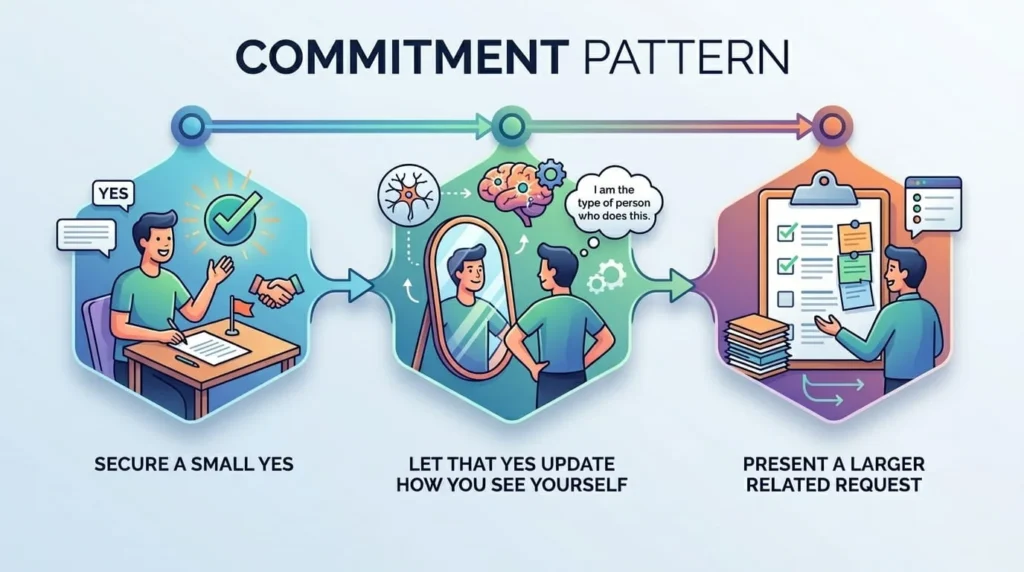
The second ask has to connect to the first. Burger’s research shows an unrelated follow-up request often fails because it breaks the logic of the initial commitment.
Marketers use identity appeals (“health-conscious runners choose this shoe”), quiz-to-email-to-purchase funnels, public pledges, and loyalty programs. Once you label yourself a brand’s customer, you tend to act in ways that defend that label.
Unity
Liking is about similarity—people who seem like you. Unity is about shared identity—a sense of “we.”
Unity grows through shared experiences, values, communities, and identities. Strong brands build member groups, not just customer lists. When belonging becomes part of who you are, resisting the brand can feel like resisting your own group.
Social identity theory explains part of the mechanism: people draw self-worth and behavior cues from in-groups, sometimes fusing their identity with the group. Campus fundraising research showed a student solicitor raised more donations by adding, “I’m a student here, too.” Family-tie studies go further: when forced to choose between saving a close friend or a disliked sibling in an emergency scenario, many participants pick the sibling—shared identity can override personal liking.
Brands build unity through exclusive communities, member clubs, insider drops, and co-creation. Asking customers for “advice” rather than “feedback” can increase partnership feelings and loyalty scores in research settings. Unity differs from consensus: social proof says others approve; unity says you belong.
Ethical Persuasion vs. Manipulation
Influence is not automatically unethical. Teachers, coaches, parents, managers, and friends persuade you every day. The question is whether their tactics respect your ability to choose what’s best for you. Ethical persuasion gives transparent information, addresses a real need, and builds trust over time. Manipulative persuasion leans on deception, fake urgency, manufactured proof, or pressure that makes you feel compelled to do something you aren’t ready or willing to do.
Becoming a Smarter Consumer
Before you click buy, pause long enough to ask: Is this claim verifiable? Is the urgency real? Am I deciding, or am I being rushed? Is this page informing me or pressuring me?
Learning to pause and ask yourself these questions is how you become a smarter consumer. Knowing these psychological triggers does not make you immune to them. But it gives you a checklist when FOMO, a star rating, or a free trial comes up. Letting you decide how you want to commit your time, energy, and money to the many opportunities available both online and in-person.