Career Development & Pathway Planning
“What do you want to be when you grow up?” is often the first career question anyone asks you. As a kid, the answer might change every week, from astronaut to chef and then engineer. Eventually, you select high school courses, scan job boards, and decide whether to stick with a familiar path or pivot to something entirely new.
Career planning is not a single decision you make at seventeen and lock in forever. It is a continuous cycle of learning, testing, and adapting as your skills, the economy, and your own priorities shift. The labor market will evolve whether you prepare for it or not. Your job is to read these economic signals and build habits that allow you to pivot when conditions change.

Career Planning Process and Principles
Career planning operates as a repeating four-step loop: know yourself, explore options, decide on a direction, and take action. In the first stage, you audit your personal skills, core values, and raw interests. In the second, you research labor market trends, wage data, and training requirements. In the third, you set concrete goals and run reality-tests on your options. In the final stage, you gain hands-on experience, apply for opportunities, and gather feedback. The moment your circumstances or goals shift, the loop starts over.
Two academic frameworks explain why this career loop remains active throughout your life.
Donald Super’s Life-Span, Life-Space Theory
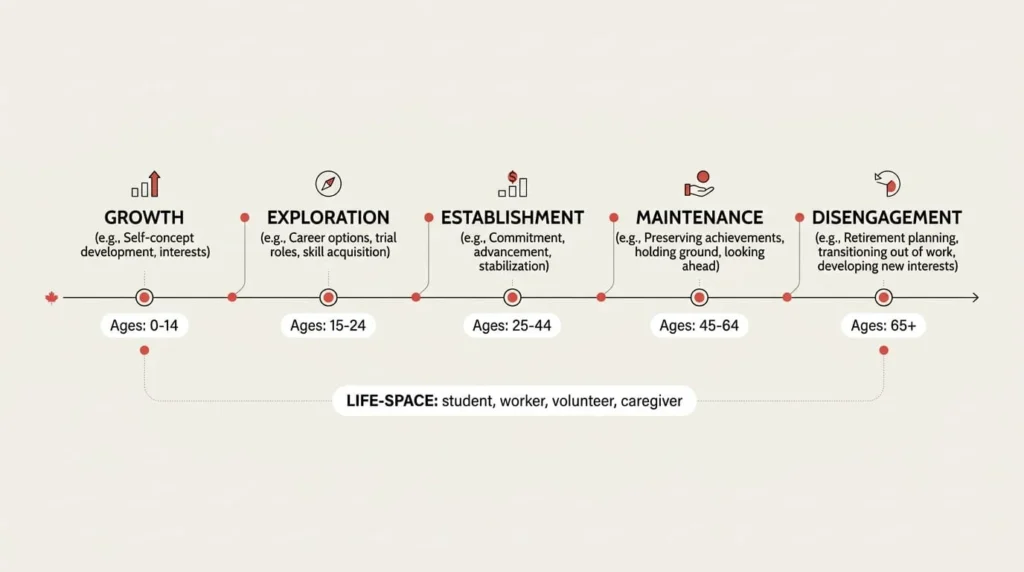
Donald Super argued that a career develops from your self-concept over a lifetime, rather than a single choice made in high school. He mapped this journey across five broad stages: Growth (birth to age 14), Exploration (ages 15 to 24), Establishment (ages 25 to 44), Maintenance (ages 45 to 64), and Disengagement (ages 65 and older). Super observed that people often navigate multiple life roles simultaneously. At any given moment, you might be a student, a part-time employee, a volunteer, and a family caregiver. He termed this overlap your “life-space.” Ultimately, your career is the complex pattern these roles form together, not a single job title.
John Holland’s RIASEC Model
John Holland sorted work environments into six types:
- Realistic (hands-on, physical)
- Investigative (research, analysis)
- Artistic (creative expression)
- Social (helping and teaching)
- Enterprising (leading and persuading)
- Conventional (organizing data and processes).
The acronym is RIASEC. Holland’s point was practical: people tend to stay longer and perform better when their personality fits the culture of the workplace. A mismatch does not mean failure, but it often means more friction and less satisfaction.
Before you start scrolling through online job postings, you must answer a more difficult question: Who are you right now? Write down your current skills, core values, interests, and natural strengths. Consider what motivates you to work hard on an exhausting Tuesday afternoon. Your personal confidence, family background, cultural expectations, and friend group all influence which career paths feel realistic or entirely closed off. Your core values act as invisible filters on every decision you make regarding your education, employment, and money.
Reading the Labor Market
Labor Market Information (LMI) is data about jobs: which occupations are growing or shrinking, what they pay, what credentials they require, and where demand is headed. You can find LMI at the local, provincial or state, national, and international level. Government labor departments, industry associations, and university career centers publish reports you can search by region and occupation.
Treat LMI like a weather forecast. It will not tell you exactly which company will hire you next June. However, you’ll discover whether demand for dental assistants, software testers, or welders is rising in your province or state—and what that might mean for your training choices.
Global projections suggest heavy job churn through 2030. Roughly 22% of current occupations may see major structural change: about 14% of roles could be new or expanded (around 170 million jobs worldwide) while about 8% could shrink or disappear (around 92 million). The net effect is still growth, but the mix shifts. Technology—especially automation and AI—drives much of that shift. So does the green transition toward renewable energy and lower emissions. Aging populations in many countries mean fewer workers supporting more retirees, which pushes employers to compete harder for talent in some sectors.
In recent employer surveys, about half of employers say they are reshaping business models around AI. A large share plan to hire for AI-related skills. At the same time, automation has raised the value of work that machines handle poorly: clear communication, teamwork, and judgment under pressure. Jobs requiring high social skills have grown faster than the average over recent decades.
Occupational Resources and Earning Potential
To compare careers on your short list, build a simple research table. Pick three to five occupations that interest you. For each one, note typical entry education, median wage in your region, projected growth, and one person you could interview or shadow. In the United States, the Bureau of Labor Statistics Occupational Outlook Handbook does the same by state and metro area. Industry sites, union wage scales, and posted job ads fill in gaps. In Canada, Job Bank (jobbank.gc.ca) publishes wage data by province and territory.
Here is a fictious example to give you an idea.
| Job Title | Education Requirements | Average Wage | Projected Growth | Person to interview or shadow |
|---|---|---|---|---|
| Welder | High school diploma + 3–4 year apprenticeship | ~$52,000–$62,000/year full-time | Steady demand in construction, manufacturing, and infrastructure | Ask your co-op office or a trades teacher for an introduction |
| Dental assistant | 1-year college certificate or diploma | ~$48,000–$55,000/year | Linked to healthcare demand and aging population | Call your dental clinic and ask if shadowing is allowed |
| Electrician | High school diploma + 4–5 year apprenticeship | ~$58,000–$72,000/year full-time | Residential, commercial, and solar/EV-related work in many markets | Ask a local union training centre to arrange a job shadow |
Earning potential matters, but a high median wage means little if the field requires eight years of school you cannot fund yet—or if openings are rare where you live. Cross-check salary data with hiring volume and your own timeline. A $90,000 career that needs a graduate degree and ten years of experience is a different bet than a $55,000 trade that pays apprentices from year one.
Building a 3-to-5-Year Plan
A generation ago, employees could expect to stay with one employer for decades. That level of stability is rare today. Corporate mergers, technological shifts, and sudden industry shocks force modern workers to retrain, relocate, and switch sectors multiple times over their lives. To navigate this volatility, you need a transition plan covering the next three to five years. Write this plan down, review it regularly, and change it the moment the economic facts change.
Six Stages of a Living Plan
Stage 1: Baseline assessment
List education, paid and unpaid experiences, skills you can prove, and gaps you already know about. Note recent wins, your personal goals, and values that keep showing up when you make hard choices.
Stage 2: Vision for the next 3 to 5 years
Write a short letter to yourself dated three and five years from now, describing work you hope to be doing. Then draft a “five-year resume” as if you had already earned the credentials and titles you are aiming for. Research real job postings and read profiles of people in those roles so your draft stays grounded.
Stage 3: SMART goals
Break the long vision into smaller steps. SMART goals are Specific, Measurable, Achievable, Relevant, and Time-bound. “Get better at coding” is vague. “Complete an online Python certificate by December and build one portfolio project” is actionable.
Stage 4: Implementation
Put goals on paper in a career action plan: certifications, courses, co-op applications, or networking etc. Block time weekly for your most important task. Link new habits to routines you already have, like study at lunch, not “whenever I feel motivated.
Stage 5: Accountability
Share goals with a mentor, teacher, manager, or a peer who will ask honest questions about your progress. Schedule brief weekly check-ins and a longer monthly review.
Stage 6: Systematic review
Labor markets move. So do personal circumstances. Revisit the plan every quarter. Drop goals that no longer fit. Add new ones when LMI or your interests shift.
Learning from Other People’s Paths
You do not have to invent a route from scratch. Interview alumni from your school, relatives in trades or professions you are curious about, or workers you meet through volunteering. Ask what they studied, what they wish they had done differently, and how they found their first role in the field. One person’s path will not be yours, but patterns emerge: which credentials actually opened doors, which jobs were stepping stones, and which detours cost time.
High School and Early Pathways
You can start building your career pathway before you graduate. Map your high school course selections against your province’s or state’s graduation requirements to ensure you qualify for your next step.
Academic + co-op + trade pre-apprenticeship:
One student might combine advanced academic courses with a local co-op placement and a summer pre-apprenticeship in the skilled trades.
Dual enrollment + retail + volunteering:
Another student might choose dual-enrollment college credits, a part-time retail job to build customer-service skills, and a community volunteer role to secure strong professional references.
Your master plan can easily combine self-discovery, market data, post-secondary applications, part-time work, and volunteering, provided you keep your weekly schedule manageable.
Student Work Experience and Community Resources
Paid work, co-op placements, and volunteering all count as experience employers notice. However, each path has trade-offs that have an impact on your performance in school and in other areas of your life.
10 to 19 hours per week:
Working 10 to 19 hours per week during the school year forces you to build strong time-management habits. Research links moderate work hours to faster post-graduation hiring and higher starting salaries. Your paycheques can cover daily expenses like transit and food, while your workplace introduces you to professional adults who can write references or alert you to hidden job openings.
Over 20 hours per week:
Pushing past 20 hours of work per week while carrying a full academic course load introduces serious risks. You face chronic fatigue, sleep deprivation, and falling grades. Curriculum guidelines warn that while job experience builds employability, excessive work hours destroy academic performance and increase high school dropout rates.
Job Shadowing and Informational Interviews
Job shadowing involves spending a workday observing a professional as they perform their daily tasks. You watch their meetings, monitor their workflow, and experience the actual pace of the environment. This helps you determine if the daily reality of the career matches your expectations. Your school’s guidance office, co-op coordinators, and family connections can often set up these opportunities.

An informational interview is a brief, 20-minute conversation with a professional working in your target industry. You use this meeting to gather intelligence, not to ask for a job. Prepare targeted questions about their daily responsibilities, required credentials, and career entry points. Always send a brief, written thank-you note within 24 hours. Most professionals gladly agree to these short interviews because a mentor once did the same for them.
Volunteering systematically fills gaps on your resume, develops your transferable skills, and connects you to professional references. This pathway is exceptionally valuable for newcomers building local work history in Canada or the United States. A reliable volunteer who works hard at a local food bank, runs a coding club, or coordinates a community festival is often the first person managers hire when a paid position opens up.
Occupational Profiles, Resumes, and the Hidden Job Market
A personal occupational profile is your working file on a target career. It pulls together LMI, shadow and interview notes, wage ranges, required licenses, and risks (automation exposure, seasonal hiring, physical demands). Update it when you learn something new. Over time you build a network of information—contacts, articles, and firsthand observations—not just a list of job titles.
Between 70% and 80% of open positions are never published on public job boards. Instead, employers fill these roles using internal promotions and employee referrals. Referrals significantly reduce hiring risks, eliminate recruitment costs, and accelerate onboarding. This massive, unadvertised sector is known as the hidden job market. Accessing it requires an active relationship-building strategy rather than mindlessly clicking “apply” on dozens of generic job postings.
Build a target list of 20 to 30 organizations you respect and monitor their press releases, funding updates, and new office locations. When you reach out to these companies, customize your message around a specific development you recently read about. Optimize your resume and digital portfolio with concrete keywords pulled from real job descriptions. Use exact metrics to prove your professional impact, such as “trained 12 volunteers” or “reduced customer checkout times by 15%.” Modern applicant tracking systems (ATS) scan resumes for these specific terms before a human ever reviews the file.
Portfolios are vital across creative, technical, and trade industries. Compile your certifications, project photographs, code repositories, or design files in a central, shareable folder. Presenting a clean, one-page personal website or a structured PDF portfolio makes you stand out far more than a candidate submitting a generic resume.
Networking
Networking is the disciplined practice of building professional relationships so that information, advice, and job leads flow in both directions. The goal is not to collect business cards or pitch your resume to strangers. Instead, stay curious about other people’s careers, offer assistance whenever possible, and remain visible so professionals remember you when a position opens up.
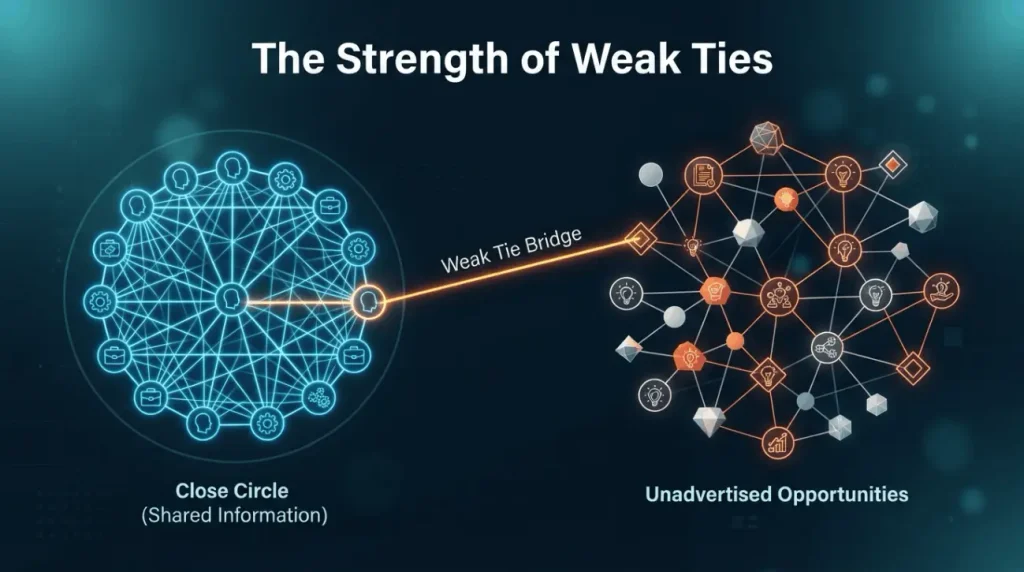
Sociological research shows that your “weak ties“—such as casual acquaintances, former classmates, or friends-of-friends—are far more valuable for finding jobs than your close friends. Because your close friends share your immediate social circle, they rarely possess unique information. Weak ties act as bridges, connecting you to entirely new networks and unadvertised opportunities.
If you are introverted, you can still network on your own terms. Comment thoughtfully on industry articles, attend small technical workshops rather than chaotic networking mixers, and request structured, one-on-one informational interviews. Generosity operates at any scale: you can share a helpful report, congratulate an acquaintance on a new project, or introduce two professionals who share a mutual interest.
Regional Job Search Assistance Programs
You do not have to navigate the labor market by yourself. Government agencies provide free career counseling, technical training, wage subsidies, and job placements—particularly for youth, newcomers, and individuals facing systemic barriers.
The United States splits similar services across age groups and barriers. Job Corps offers free residential career training for ages 16 to 24 from low-income households. GetMyFuture (careeronestop.org) provides planning tools for ages 14 to 24. Local youth programs through American Job Centers deliver work-readiness training, summer internships, and year-round support for in-school youth (16 to 21) and out-of-school youth (16 to 24).
American Job Centers (AJCs), coordinated under the Workforce Innovation and Opportunity Act (WIOA), operate as one-stop hubs: coaching, skills assessments, resume help, and training referrals. CareerOneStop, sponsored by the U.S. Department of Labor, is the national web portal for job search planning, training programs, and education funding options.
Targeted programs address specific groups. Veterans and military spouses can access transition employment services. The Regional Apprenticeship Development and Readiness (RADAR) Project and organizations like Work Opportunities Unlimited connect people with disabilities to apprenticeships and placements in fields such as manufacturing, IT, and healthcare. The Native American Program Finder links tribal community organizations to employment and education support. The Senior Community Service Employment Program (SCSEP) trains older workers through community service assignments that build skills for competitive jobs.
In Quebec, Carrefours jeunesse-emploi (CJEs) support young adults aged 15 to 35 across 111 locations. They help with labor market entry, returning to finish a high school diploma (DES), starting a small business, and finding community volunteer roles. Emploi-Québec runs active employment programs, career counseling, wage subsidies, and targeted job search help at the provincial level.
Across Canada, the federal government funds more than 520 settlement agencies that offer free employment services to newcomers—resume reviews adapted to Canadian norms, mock interviews, and sector mentoring. Search “employment services for newcomers” plus your city to find local offices.
| Region / program | Who it serves | What it offers |
|---|---|---|
| Carrefours jeunesse-emploi (CJEs), Quebec | Young adults aged 15 to 35 (111 locations) | Labor market entry, returning to finish a high school diploma (DES), starting a small business, and finding community volunteer roles |
| Emploi-Québec | Quebec workers broadly | Active employment programs, career counseling, wage subsidies, and targeted job search help at the provincial level |
| Canadian settlement agencies (520+) | Newcomers to Canada | Free employment services—resume reviews adapted to Canadian norms, mock interviews, and sector mentoring |
| Job Corps (U.S.) | Ages 16 to 24 from low-income households | Free residential career training, Planning tools for youth |
| American Job Centers (AJCs) / WIOA (U.S.) | Youth and workers facing barriers | One-stop hubs: coaching, skills assessments, resume help, and training referrals; in-school youth (16 to 21) and out-of-school youth (16 to 24) programs |
| CareerOneStop (U.S.) | National audience | Web portal for job search planning, training programs, and education funding options |
| Targeted U.S. programs | Veterans, military spouses, people with disabilities, tribal communities, older workers | Transition employment services, apprenticeships and placements, employment and education support, community service skill-building |
Employment assistance programs vary significantly by postal and zip code. Always search official government employment portals for your province, territory, or state before paying a private firm for job placement services.
Securing, Creating, and Maintaining Employment
Securing an offer is only your first milestone. Keeping your job, earning promotions, and knowing when to leave are distinct professional skills.
Labor market projections indicate that employers will dedicate a larger portion of their revenues to wages by 2030 as they compete for highly skilled workers. However, this macro trend does not guarantee you a raise. To earn higher compensation, you must document your achievements in writing and negotiate with proof of performance. Ask your supervisor what high performance looks like in your department. When you accept stretch assignments—projects that push you slightly past your comfort zone—ensure you secure managerial support and clear expectations so you do not simply absorb extra work under the same job title.
Workplace requirements will continue to evolve rapidly. Your transferable habits, like communication skills or professional adaptability—will easily outlast any single job title. Cultivate these habits on purpose.
When your personal goals or real-world labor data contradict your career plan, rewrite it. A pathway that seemed logical at sixteen can collapse at nineteen if automation replaces your target entry-level jobs, or if you discover you prefer hands-on fieldwork to a desk job. This pivot is not a failure. It is the career planning loop operating exactly as Super and Holland designed it: you learn, you adjust, and you act again.