Ethics In Marketing
Ethics are a code of values and principles that govern the actions of a person regarding what is right versus what is wrong. They determine our behavior when faced with a moral dilemma. Morals are subjective, in that they vary from person to person depending on their point of view, and the ethical standards of their culture. Ethical practices, as well as unethical practices, can have an effect on marketing, and in some instances, unethical behavior can lead to government intervention. Also, our ethical choices and moral philosophies are relative to marketing practices.
Ethical Issues and Their Impact on Marketing
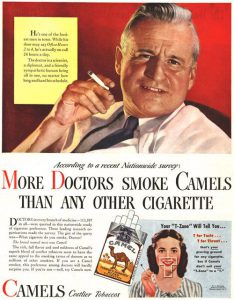
Advertisements are a great way to spread knowledge about a product or service, but sometimes the messages in advertisements are questionable. Vintage advertisements from the 1950s and 1960s, for example, were created in an era with far less oversight. Today, many of these ads are seen as more offensive and unethical than persuasive. If you look at an ad for Camels cigarettes from the 1950s, you’ll see a doctor smiling while holding a cigarette, with the caption, “More doctors smoke Camels than any other cigarette”. This ad is hypocritical since doctors spend their careers advocating for healthy lifestyles. It also sends a message to society that if doctors are smoking then it must not be bad.
In marketing, the strategy of promotion is used to gain the interest of consumers and to persuade them to try a product or service, but too often, the objectification of women is implemented in this strategy. Carl’s Jr. is well known for doing so. Since 2000, the majority of their advertisements include models eating hamburgers and wearing revealing clothing. Carl’s Jr. defends their actions by saying “We believe in putting hot models in our commercials, because ugly ones don’t sell burgers.” Because of their unethical choice to objectify women, many women believe they are not the target audience, but that males age 18 – 35 are.
Ethical and Unethical Data Collection
Before a new product or service is released, research is conducted to gain feedback on how well it will test in the market. An ethical marketing research strategy used to gain this information is focus groups. The main purpose of focus groups is to get the consumers’ opinions, beliefs, or perceptions about a product or service. This form of qualitative research consists of a moderator that interviews a small group of people, or respondents. The interview is set up in an informal way, so the respondents are free to give their stance without restrictions.
Another strategy is data collection. Many websites such as Google, Facebook, and Amazon collect information including users’ search history, purchase history, payment card information, social media activity, contact information, and location data. This information helps businesses build customer profiles and deliver advertisements that are tailored to consumers’ interests. However, collecting or storing personal information without consumers fully understanding how it will be used can violate their privacy and damage trust.
Ethical marketers should be transparent about what data they collect, obtain consent where required, securely store customer information, retain it only as long as necessary, and carefully manage how data is shared with partners or third parties. While customer data can improve marketing by helping businesses better understand and reach their audiences, misuse of that data can lead to lost customers, reputational damage, conflicts with consumer values, and government penalties. Data privacy continues to be one of the most important ethical issues in modern marketing.
Growth Hacking
“Growth Hacking” is the practice of using automatic friend invites and push notifications from apps to try to pull in your friends lists. “Growth Hacking” pushes the ethical boundaries of what consumers will accept from marketers – many consumers see this as such a turn-off that they will discontinue the service entirely. From a business perspective, saving customer data for future use can also be a major legal problem, even if you try to discontinue use of the service. This is an evolving field in marketing. Just like the cigarette ads are considered silly and offensive today, these types of marketing practices could either become the norm, or serve as an example of bad practice when looking back.
Digital Marketing Risks
Digital marketing also creates opportunities for unethical behavior that can harm consumers. Examples include deceptive text messages (known as smishing), abusive telemarketing practices, and businesses that fail to properly secure customer payment information or other sensitive documents during online transactions. These practices can expose consumers to fraud, financial loss, and identity theft. Consumers who believe they have been targeted by these types of scams should report them to the appropriate authorities and take steps to protect their personal information. More detailed guidance on recognizing and recovering from identity theft is covered in How to Avoid Identity Theft, Scams & Fraud.
Ethical Standards in International Markets

Culture has a big influence on ethical principles since it refers to a set of values and attitudes that are shared among a group of people. However, not all cultures are the same which makes ethics vary among countries. Ethical standards should be relevant to international markets and should be equal in all markets, meaning that ethical practices carried out in the home country should be carried out internationally as well. Avon (AVM)is committed to this. The marketing strategy they use to distribute their products in Asia, Europe, and South America, is the same marketing strategy they use in the United States: Direct Selling. Avon recruits many local sellers, who then market the beauty products individually to friends, professional contacts, and others. By using this direct marketing strategy, Avon tries to make sure its marketing efforts are specifically tailored to micro-markets, avoiding ethical complications.
At the same time, this same strategy has potential for abuse. Herbalife (HLF) is constantly dodging lawsuits challenging that it operates as a pyramid scheme, making more of its money by requiring membership fees and minimum payments from its individual sellers than it does by selling its products. These lawsuits push the boundaries of marketing ethics, and many consumers avoid Herbalife’s products because of the allegations. Consumers should also be cautious of businesses that emphasize recruiting new members or collecting membership fees over selling legitimate products or services, as these may be signs of unethical multi-level marketing (MLM) or pyramid schemes. Individuals should always verify a business opportunity before participating.
Ethics, Investors, and ESG
Ethical marketing is also important to investors. Many investors evaluate companies based on Environmental, Social, and Governance (ESG) factors when making investment decisions. As a result, businesses must ensure that claims about sustainability, diversity, or other social initiatives are truthful and supported by evidence. Disclosure requirements and anti-fraud regulations help prevent companies from making misleading marketing claims that could deceive both consumers and investors.
Unethical Behavior and Government Regulation
Unethical behavior in marketing can include misleading advertising, price gouging, predatory pricing, abusive telemarketing, spam emails, and deceptive online marketing practices. To protect consumers, businesses are legally required to ensure that their marketing claims are truthful, honest, and not misleading. In the United States, the Federal Trade Commission (FTC) enforces many advertising and consumer protection laws, while the Consumer Financial Protection Bureau (CFPB) oversees many financial products and services. State attorneys general and local consumer protection agencies may also investigate deceptive marketing practices. Consumers who encounter scams or deceptive marketing should report the activity to the appropriate authorities and take steps to protect their personal information.
As more marketers and advertising campaigns push ethical boundaries, the government is forced to step in to put hard limits on what can, and cannot, be done. Introducing government regulation means marketers are not only punished by public opinion for unethical behavior, but also face high fines and other legal penalties.
A Code of Ethical Behavior for Marketing
When it comes to marketing, a code of ethics should be put in place that imposes ethical principles on marketing practices. First and foremost, it should be mandatory for marketers to adhere to all laws and regulations. Marketers should accept responsibility for the consequences of their actions, and ensure that their decisions and actions satisfy consumers. They should be honest and uphold dignity when serving consumers and make sure the products and services they are offering are safe and match consumers’ intentions. Marketers should also disclose risks associated with the product or service, and avoid false advertising and misleading tactics.
Every company’s marketing approach is different, so every company should have a strong ethical code to guide their marketing efforts. Marketers should refer to this code before and during every marketing campaign – otherwise the company risks a serious public, and perhaps even legal, backlash.
Consumer Decision Lens
Ethical marketing recognizes that consumers make purchasing decisions based on many factors, including price, quality, availability, personal preferences, and the influence of advertising and promotion. Because marketing can shape consumer perceptions and purchasing behavior, businesses have a responsibility to communicate honestly and avoid misleading consumers.
The Connection Between Moral Philosophy and Marketing Practices
In the end, ethical choices are based on our personal moral philosophy. Our moral philosophy is based on the kind of society we live in and what we surround ourselves with. Two kinds of moral philosophies that have a connection to marketing practices are moral idealism and utilitarianism.
Moral idealism is a moral philosophy that no matter what the outcome, individual rights must always be protected. This philosophy can be found in the ethical practice of informing consumers of safety hazards in a product or service, or recalling a defective product no matter the cost, so long as consumers are protected.
Utilitarianism is based on the overall outcome and evaluates the costs and benefits of ethical behavior. The goal is to achieve happiness for the greatest amount of people. If the benefits are greater than the costs, then that behavior is ethical. Utilitarianism in marketing provides value to its consumers. Samsung achieves this by setting up cell phone charging stations in airports for passengers. This provides a valuable service to Samsung’s customers and even the ones who are not, since the charging stations can charge any device.
Marketing is not just about promoting and selling products to consumers. It’s about putting forth ethics in marketing practices to eliminate deception, and to guarantee that consumers are getting the most out of a product or service.